Understand advertising attribution and customer results
Learn how website visits, inquiries, reservations, and payments connect to Google and Meta advertising results.
Visit and inquiry counts do not show the full advertising result. Connect inquiries to reservations and completed payments to compare the customer quality of each campaign.
Laney saves advertising attribution with the customer record. It can send customer status, reservation, and payment results to connected analytics and advertising services. This page explains how the components work together.
Results to measure
Marketing teams need to answer questions across the customer journey.
- Which advertisement produced the website visit?
- Which advertisement produced the inquiry?
- Which inquiries became qualified customers?
- Which customers made and completed reservations?
- Which customers completed payments?
- How do campaign cost and customer results compare?
Google Analytics 4 and Google Tag Manager are the starting point for website measurement. Later customer results usually live in customer, reservation, and payment records. When these areas are separate, an advertising service can see an inquiry but not its final result.
Laney keeps common attribution data between acquisition and later customer results. Marketing teams can compare inquiries, qualified customers, reservations, and completed payments.

Tags show visits. Connected data also shows customer results.
GA4 and GTM
Google Analytics 4 and Google Tag Manager have different roles.
| Tool | Role | What it measures | What needs another connection |
|---|---|---|---|
| Google Analytics 4 | Website analytics | Visits, pages, acquisition, and events | Customer status, reservations, and payments |
| Google Tag Manager | Tag deployment | Which tags run on each page | Customer storage and server conversions |
| Google Ads tag | Google browser conversion measurement | Configured website conversions | Later customer results |
| Meta Pixel | Meta browser conversion measurement | Page views, inquiries, and payment events | Server and later customer results |
GTM deploys tags. It does not store customer records or manage reservation and payment states. A complete connection needs the website, customer data, and server conversion delivery.
One customer journey
The next diagram follows a customer from a Google advertising click to an inquiry and payment.
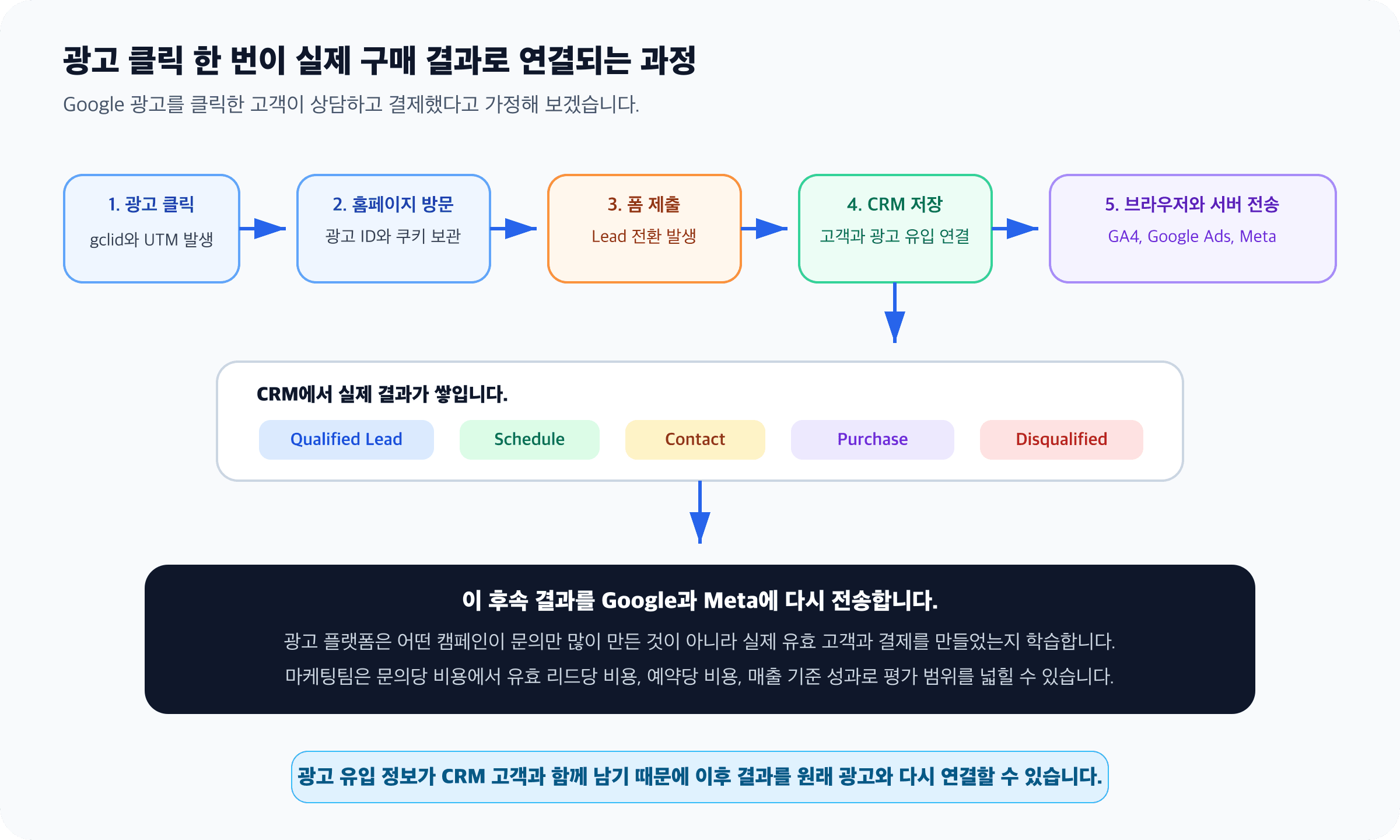
Click, inquiry, reservation, and payment are connected.
Advertising click
An advertising service can add a click identifier to the landing URL. Google can use gclid,
gbraid, or wbraid. Meta can use fbclid, _fbp, and _fbc.
A click identifier is not the customer name. It connects a visit to advertising activity. UTM parameters can also record the source, medium, campaign, content, and keyword.
First and latest attribution
A customer can visit more than once. Laney keeps first and latest attribution separately.
- First attribution shows where the customer relationship started.
- Latest attribution shows the campaign nearest to an inquiry or reservation.
- Existing UTM and click ID fields remain compatible with first attribution.
- Separate latest fields hold the newest tagged advertising visit.
- Attribution refreshes after its retention period expires.
Use first attribution to review discovery. Use latest attribution to compare the campaign nearest to the result.
Website and form
When the visitor allows analytics or advertising measurement, the website stores only the permitted attribution data. A submitted form saves the attribution with the customer record.
A selected button is not the same as a stored form. Laney can create an inquiry conversion after the server confirms the customer and form record.
Customer, reservation, and payment
An inquiry can produce several operating results.
- The team confirms a contactable and suitable customer.
- The customer schedules a consultation or visit.
- The consultation or visit is completed.
- The customer completes a payment.
- The team marks a duplicate or unsuitable inquiry.
Each result can be a separate conversion stage. Do not make every stage a primary advertising goal. Start with stages that the organization can manage consistently.
Result delivery
After a customer, reservation, or payment result is confirmed, Laney can send a server conversion to connected Google and Meta services. The advertising service can use later results in campaign reporting and optimization.
Conversion delivery does not guarantee a specific outcome. Budget, conversion volume, campaign settings, and provider attribution rules also affect results.
Browser and server measurement
The browser and server know different facts.
| Method | Information it knows well | Main role |
|---|---|---|
| Browser | Pages and actions on the website | Visit and website behavior analysis |
| Server | Stored inquiries, reservations, and payments | Confirmed operating result delivery |
Browser signals can be limited when a visitor denies measurement, blocks tags, restricts cookies, or leaves before delivery. Server measurement confirms stored results, but it does not bypass the visitor's choice. Missing identifiers can prevent an event from matching an advertisement.
Visitor data choices
Laney websites can ask separately for visit analytics, advertising measurement, and personalized advertising.
- Visit analytics can load Google Analytics.
- Advertising measurement can load Google Ads and Meta Pixel.
- Personalized advertising is available only with advertising measurement.
- Essential only keeps analytics and advertising tags unloaded.
- A visitor can reopen Data settings and change the choice.
The same choice is stored with form attribution and applied to server conversion delivery. Google
tags receive analytics_storage, ad_storage, ad_user_data, and ad_personalization states.
Hashing does not replace consent. Do not send consultation notes or sensitive information to an advertising service. Review the privacy notice and collection text with the organization.
Google enhanced conversions
Google enhanced conversions normalize and SHA-256 hash customer-provided email addresses and phone numbers. The values supplement existing conversion measurement.
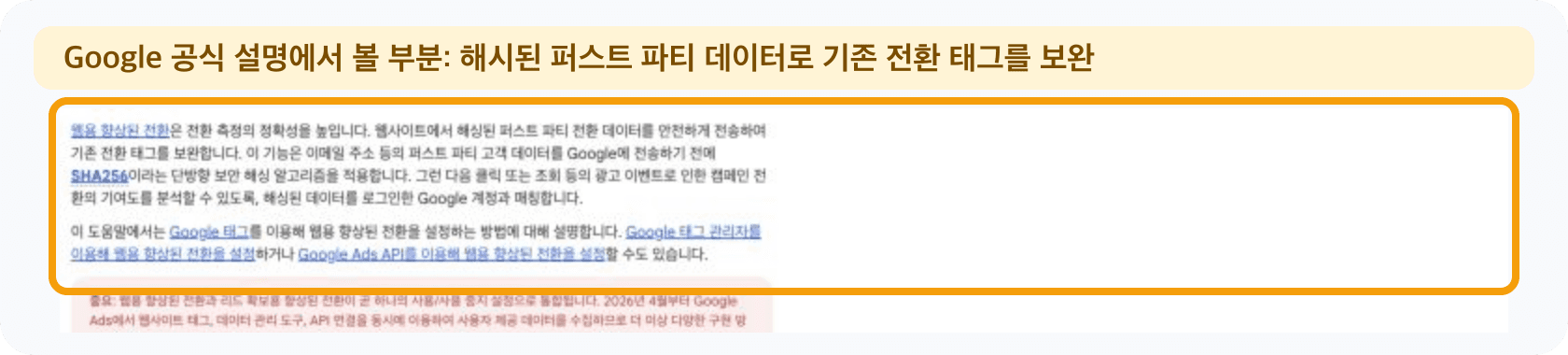
Source: Google Ads Help. The highlighted area shows hashed first-party data supplementing a conversion tag. Captured on 2026-08-31.
Laney prepares customer-provided data as follows.
- It normalizes whitespace and format.
- It applies Google's Gmail period and plus-address rules.
- It formats phone numbers as full E.164 values.
- It hashes normalized values with SHA-256.
- It uses the values only when advertising measurement is allowed.
Google Data Manager
Google Data Manager is the official server interface for advertiser-owned conversion data. An event can include time, transaction ID, value, click identifiers, and hashed customer data.
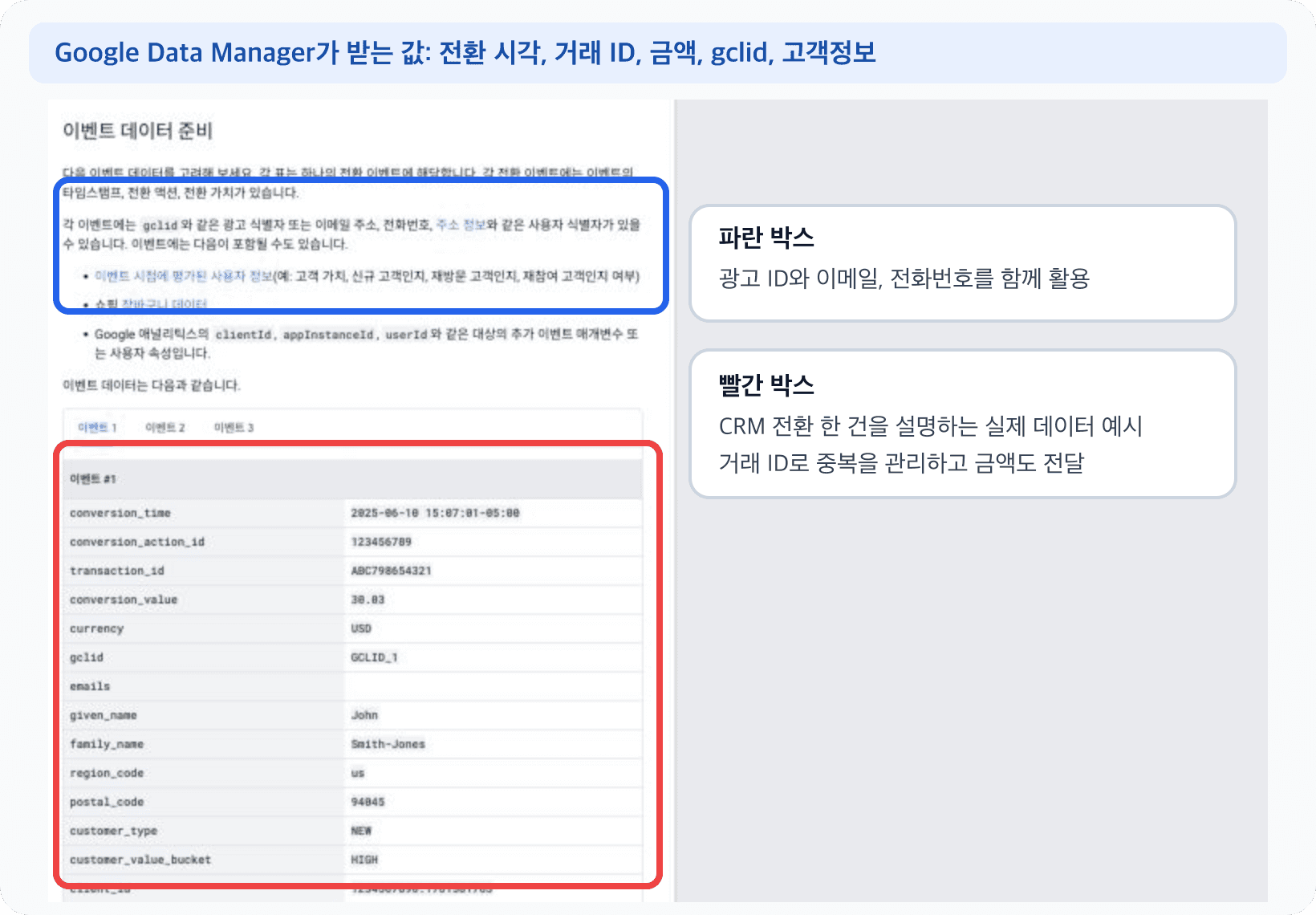
Source: Google Data Manager API. The image highlights advertising identifiers, customer identifiers, transaction ID, and value. Captured on 2026-08-31.
A Laney server event can include the following data.
- A unique event ID as
transactionId - An available
gclid,gbraid,wbraid, ordclid - Hashed email address and phone number
- Conversion time
- Payment value and currency
- Advertising data and personalization choices
Laney retries temporary network and provider failures a limited number of times. It records a final failure with the provider, event, and error details.
An optional Google Ads browser tag can use the same transaction ID as the server event. Configure the conversion ID and event labels to use the same conversion actions.
Meta Pixel and Conversions API
Meta Pixel sends browser page views and conversion events. Meta Conversions API sends events from a server or customer management system.
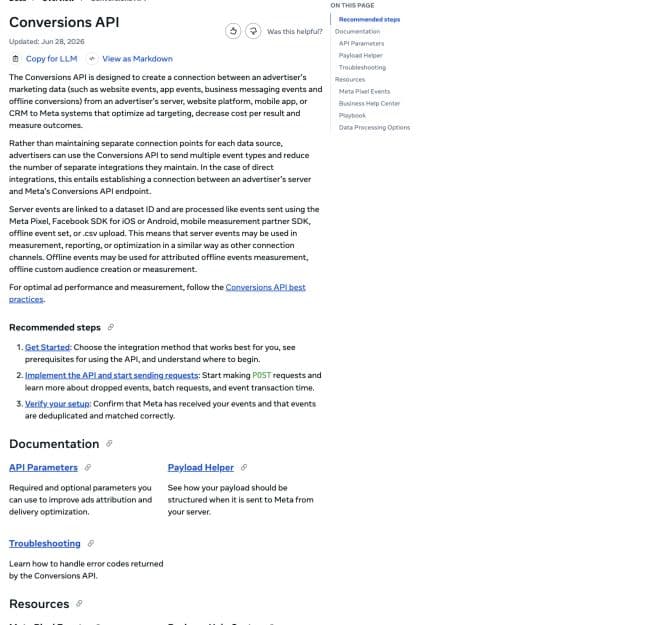
Source: Meta Conversions API. The page shows website, server, and customer management data connections. Captured on 2026-08-31.
A Meta server event can include the event name, time, event_id, hashed customer data, _fbp,
_fbc, source URL, an advertising form lead_id, and payment value.
Laney does not report success when Meta returns an error or does not confirm receipt. It retries temporary errors and records a final failure.
Conversion deduplication
Pixel and Conversions API can both send the same inquiry. Use the same event name and event ID so Meta can treat the signals as one action.
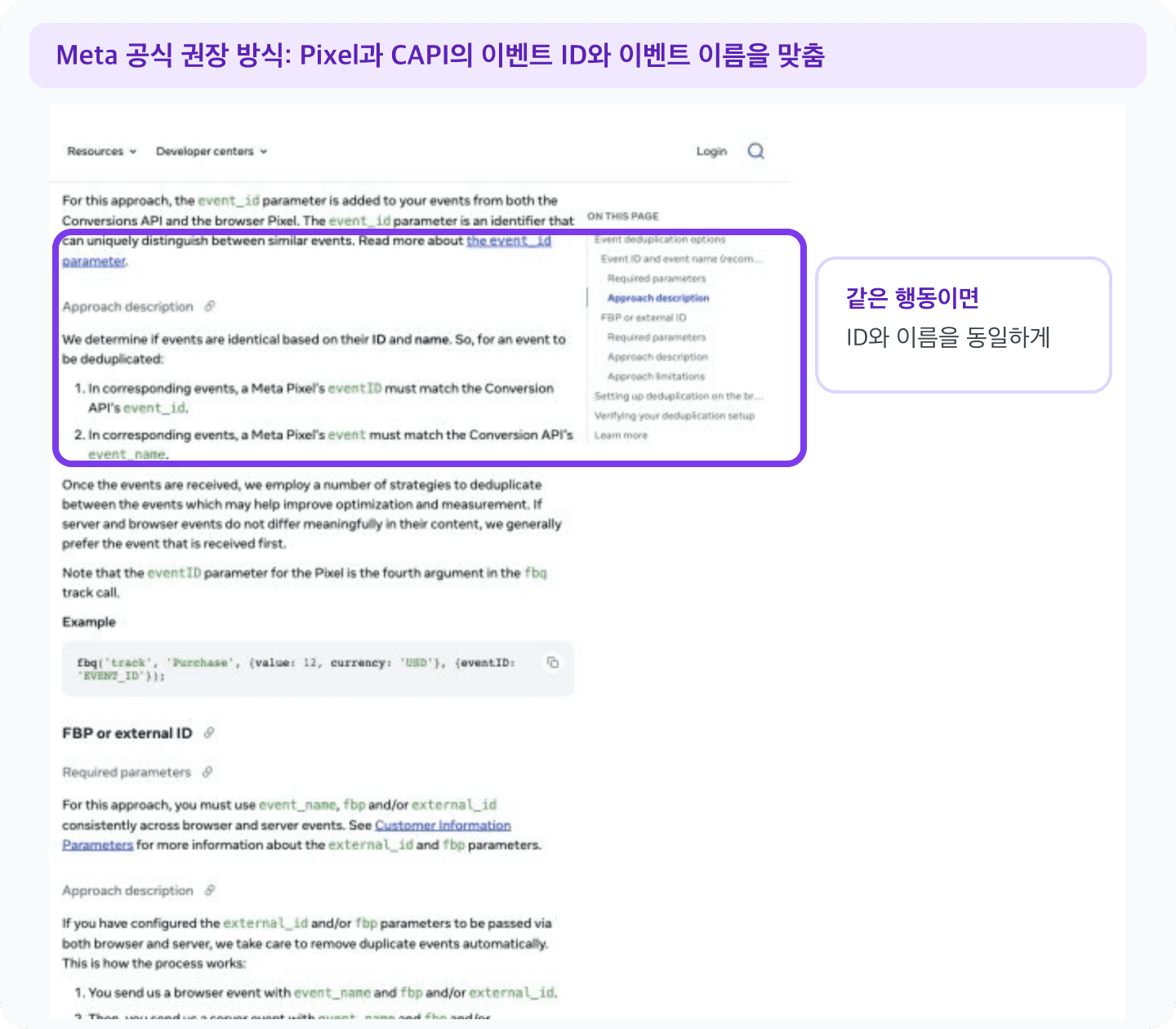
Source: Meta deduplication guide.
The image highlights matching Pixel eventID, server event_id, and event names. Captured on
2026-08-31.
Laney can use the form or reservation record ID for both browser and server events. Google Ads can use a transaction ID for the same conversion action. Google Analytics 4 uses different deduplication rules, so verify it in DebugView and reports.
Google Analytics 4 server events
The Google Analytics 4 browser tag records visits and page actions. Measurement Protocol is the official method for server events.
When a visitor allows analytics, Laney can save the Google Analytics customer and session identifiers with attribution. A later server event can use them to connect to the existing visit. Server events supplement browser collection. They do not replace page and session context.
Google and Meta advertising forms
Google and Meta advertising forms are submitted inside the advertising service. The visitor does not load the website, so website tags cannot collect these customers.
Laney can import supported form submissions as customer records. It saves the provider submission ID, campaign attribution, and an available click identifier. Later customer, reservation, and payment results can connect to that customer and return to the provider.
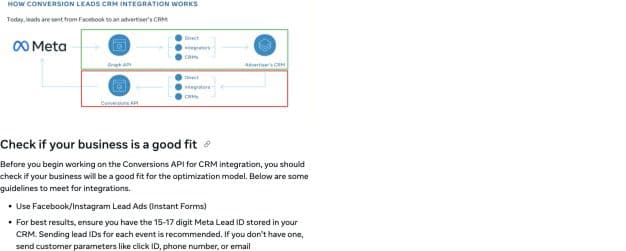
Source: Meta CRM guide. The green line brings a Meta form into the customer system. The red line returns later results. Captured on 2026-08-31.
Delivery by website type
The measurement result stays the same, but setup work depends on the website type. Laney shared landings and Laney custom landings use the same measurement engine. A separately operated website must follow the Laney integration contract.
| Website type | Included scope | Additional work |
|---|---|---|
| Laney shared landing | Data choices, consent-aware tags, UTM and click IDs, first and latest attribution, form and customer links, and browser-server deduplication | Confirm the primary domain, account access, conversion rules, and privacy text. |
| Laney custom landing | The same measurement engine as the shared landing. Common forms keep attribution, customer storage, and server conversions. | Define success rules and data for bespoke buttons, external forms, reservations, or payment paths. |
| Customer-operated external website | Laney can send stored customer, reservation, and payment results to connected advertising services. | The customer developer passes consent, UTM data, click IDs, event IDs, and stored form results through the integration contract. |
A custom landing does not rebuild measurement. Its design and some sections are customer-specific. Consent, attribution, common forms, customer records, and server conversions stay on the shared engine. Only bespoke interactions outside the common form contract need event mapping and review.
A customer-operated external website is not a Laney custom landing. The customer developer or current website agency must join installation and release work.
What the customer provides
Do not send passwords, personal sign-in details, or advertising service secret keys. Invite a Laney operator, approve a manager link, or assign required assets to the Laney partner ID.
| Area | Customer input or decision | Why it is required |
|---|---|---|
| Organization and branches | Legal or business name, branch names, addresses, phone numbers, and operating structure | Align domains, analytics properties, advertising accounts, and branch reports. |
| Domains | Primary domain, previous domains, DNS owner, and available change window | Connect the new address, issue certificates, redirect old addresses, and update map and advertising links. |
| Data rules | Privacy owner, analytics and advertising choice text, and retention rules | Apply the same visitor choice to browser tags and server conversions. |
| Conversion stages | Operating rules for inquiries, qualified customers, reservations, completed consultations, and completed payments | Decide which result is sent and when. |
| Existing Google Ads customer ID, Google Analytics property, Tag Manager container, or a decision to use new managed assets | Keep existing history and connect only the required accounts, or prepare new assets. | |
| Meta | Business Portfolio, ad account, Dataset and Pixel, Pages, and advertising forms in use | Keep Pixel, Conversions API, campaigns, and form customers in the same organization scope. |
| Agency | Current agency, agency partner ID, assigned scope, and access to retain after the contract | Give Laney and the agency separate asset access without a shared administrator password. |
| Test material | Non-customer contact details, test reservation and payment method, and acceptance owner | Verify the full path before launch. |
A Laney custom landing also needs approved copy, logos, colors, fonts, and image rights. Each public language needs approved copy. If an external reservation, payment, or form remains in use, provide its owner and test environment.
Marketing account and API access
Use one of these account models.
| Model | When to use it | Customer action | Laney action |
|---|---|---|---|
| Connect existing customer-owned assets | Keep existing campaigns, history, billing, or learning data. | Complete a user invitation, Google Ads manager approval, or Meta partner asset assignment. | Verify the asset IDs and access. Connect website and server conversions. |
| Prepare Laney-managed assets | Start a new organization or branch without existing marketing assets. | Confirm organization details, branch structure, advertising payment owner, billing owner, and required terms. | Prepare supported analytics and advertising assets under the managed structure and connect them to the organization. |
A Google Ads manager link does not change existing campaign history or user sign-ins. Billing also stays unchanged unless it is separately updated. See Google's manager account linking guide.
Google Analytics supports access at the account or property level. Google Tag Manager separates account and container permissions. Follow Google Analytics user management and Google Tag Manager user and permission management to grant only the required scope.
Meta assigns ad accounts, Datasets, Pixels, and Pages as separate Business Portfolio assets. Native forms also need lead access. See Connect a Meta ad account for the Laney partner ID and asset-sharing steps.
Laney manages the marketing API apps, manager accounts, system users, and server credentials. The customer does not send developer tokens or personal passwords. The asset owner completes any provider business verification, customer data terms, or billing approval in the provider interface.
Give an agency partner or sub-manager access in the advertising service. Do not add the agency as a Laney platform owner. The organization retains asset ownership. Laney receives integration access. The agency manages only its assigned branches and ad accounts. Remove only that partner access when the agency changes.
Delivery process
| Order | Customer or agency action | Laney action | Completion check |
|---|---|---|---|
| 1. Scope | Provide the website type, primary domain, branches, existing accounts, agencies, and primary conversions. | Review the domain and account structure. Classify assets to keep, connect, or prepare. | Website, branch, account, and owner lists agree. |
| 2. Access | Complete user invitations, manager link approvals, or partner asset assignments. | Accept invitations and verify the actual assets and permission scope. | Required accounts are available without shared passwords. |
| 3. Domain and data rules | Approve the DNS window, privacy text, and analytics and advertising choices. | Configure the domain, redirects, data choices, and tag execution rules. | The primary domain and data rules are approved. |
| 4. Website | Confirm success rules for bespoke buttons, forms, reservations, and payments. | Apply common features to shared landings. Apply the shared engine and extra event mapping to custom landings. | Only permitted tags run. Attribution reaches the stored form. |
| 5. Advertising services | Complete provider terms, business verification, and billing items that require owner approval. | Connect Google and Meta assets. Configure browser tags, enhanced conversions, and server conversions. | The account, organization, and domain scopes match. |
| 6. Test | Create a test visit, inquiry, customer status, reservation, and payment in order. | Compare customer records, click IDs, consent, event IDs, provider receipt, and duplicates. | The agreed conversions appear in Google and Meta test tools. |
| 7. Operate | Report owner, agency, domain, and conversion rule changes. | Review delivery errors and provider diagnostics. Update access and conversion settings. | Owners, asset ownership, revocation, and recurring checks are recorded. |
Some server conversion or campaign features can start later if provider business verification or API approval is incomplete. Check approval status when you set website and campaign launch dates.
Difference from tag-only measurement
| Area | Tag-only measurement | Laney connection model |
|---|---|---|
| Scope | Visits, selections, and forms | Inquiries, qualification, reservations, consultations, and payments |
| Attribution | Provider reports | First and latest attribution on the customer record |
| Collection | Browser tags | Browser and server with separate roles |
| Matching | Anonymous visits | Click IDs and permitted hashed customer data |
| Advertising goal | Inquiry count | Qualified customers, reservations, and payments |
| Advertising forms | Separate provider management | Customer records with later results |
| Deduplication | Separate tag settings | Shared browser and server event IDs |
| Consent | Separate tag behavior | One website choice for tags and server delivery |
| Ownership | Can be split by branch and agency | Organization-owned assets with member and partner access |
Account ownership and agencies
Keep organization ownership when advertising and analytics assets already exist. Give Laney and each agency only the required access. Google can place branch ad accounts under an organization-owned manager account. Meta can keep ad accounts and Datasets in an organization-owned Business Portfolio.
An organization without existing assets can select Laney-managed assets. Confirm branch structure, advertising payment and billing owners, operating access, and end-of-service handling before the connection.
Do not share a personal password. Use member, manager, or partner access so an agency change does not remove the organization's history and measurement rules.
Domain consolidation
A domain change affects more than the website address. Review advertising landing URLs, analytics and advertising domains, Meta domain verification, maps, business profiles, reservation and payment destinations, redirects, click IDs, and UTM parameters.
Test the full path from an advertising click to a form, reservation, and payment after the change.
Contrasting examples
These are synthetic examples that explain the difference in measurement.
One campaign produces many inquiries but few qualified customers or reservations. Cost per inquiry can look good, but customer and reservation results show low acquisition quality.
Another campaign produces fewer inquiries but more qualified customers, reservations, and completed payments. Payment results can change the budget decision.
Measures
Review business results and data quality together.
| Area | Measures |
|---|---|
| Acquisition | Spend, impressions, clicks, visits, and customers by campaign |
| Customers | Inquiries, qualified customers, unsuitable customers, and first response time |
| Reservations | Reservations, cost per reservation, completions, and cancellations |
| Payments | Completed payments, payment value, and advertising cost comparison |
| Data quality | Click ID coverage, delivery success, duplicates, and delay |
| Provider diagnostics | Google conversion diagnostics, Meta Event Match Quality, and Test Events |
Provider conversions and Laney customer counts do not always match. Providers use different attribution windows and counting rules. Compare the same period and conversion definition, then investigate the reason for the difference.
Limits
- Server conversion delivery still follows visitor choices and provider matching rules.
- Hashed data still needs a defined advertising purpose and handling policy.
- Incorrect access or conversion actions can prevent a connected account from receiving results.
- Provider receipt and campaign attribution are different states.
- Provider reports and customer records can use different periods and counting rules.
- Do not include consultation notes or sensitive information in advertising conversion data.
When the accounts and conversion stages are ready, follow Connect and verify advertising measurement.
Understand marketing measurement and campaigns
Learn how analytics, advertising, lead capture, and conversion measurement connect.
Connect and verify advertising measurement
Prepare the website model, account access, domains, data choices, and conversion stages, then verify Google and Meta test events.